Who Am I?

My photo
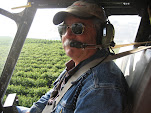
A nobody; a nitwit; a pilot; a motorcyclist; a raconteur; a lover...of life - who loves to laugh, who tries to not take myself (or anything) too seriously...just a normal guy who knows his place in the universe by being in touch with my spiritual side. What more is there?

29 October 2006

Choices

The view from my deck.
(Not bad, huh?)


The weather in Guanaja, Honduras is uncharacteristically crummy this weekend. Fortunately, I have nothing to do except some work on the helicopter that will just have to wait. I can’t even fly it to the airport and put it in the hangar to work on it because the company King Air is already there taking up that space. They’ll both fit, but the helicopter has to go in first.

Today is dismal and rainy, and the wind is out of the north, which it typically is not. Between rain bands, I found myself an unoccupied hammock and settled in with the latest issue of FLYING Magazine.

On one of the helicopter internet discussion boards that I haunt, we often discuss the merits of the career of helicopter flying as opposed to other types of flying. Although there are many jobs within the fixed-wing world, the usual other alternative (as if there is no other) is flying for the airlines. To many helicopter pilots, airline flying seems humdrum and dull…horribly, unbearably boring and unchallenging. And therefore unsuitable as a career choice. Me, I don’t know. I fly both and like both.

In the latest FLYING Magazine, columnist Dick Karl writes about a series of flights he took in the jumpseat of an American Airlines Boeing 757 piloted by fellow columnist Les Abend. They had to go through a big run-around through various agencies for all the permissions required for such a ride-along. I’m sure American expected a big feature article with pictures of their shiny airplanes in picturesque locales. Instead, they got an expanded version of Dick Karl’s regular monthly column. Oops.

The four-day trip began in Ft. Lauderdale, Florida with stops in San Juan, P.R., Orlando, Fl., Boston, Ma., San Juan (again) and then back to Ft. Lauderdale. It is informative on many levels.

Yes, airline flying is routine; by its nature it must be so to guarantee a certain level of safety through standardization. But that doesn’t mean that airliners can be flown by robots. There are still humans up there in the pointy end, always more than one of them. Les and his copilot on that trip matrix had flown together a lot, and their friendship comes through. It’s nice, flying with someone you get along with and whose company you enjoy. Yes, the inside jokes get predictable, but that happens with any small group of people.

The amateur psychologist in me suspects that a common trait among helicopter pilots is a dislike of the participation in team sports. It is often said (by us!) that we are loners or “lone wolves” and I believe that to be true. Something in our psyche makes us not like working/playing so closely with others. To really enjoy airline flying, one must necessarily enjoy working in concert with someone who is, for all practical purposes, a co-equal.

After reading the magazine, I was on my way back to my house when one of our guests stopped me. “How long have you been flying helicopters?” he asked. I had to think. My first flying job was…what…1980? While I sorted it out he said, “Must be a long time if you have to think about it, huh?” Yeah, it’s been a long time all right.

The question and the article made me think back on my career. I’ve always flown by myself, with the exception of one short stint I did as an copilot in a Sikorsky S-58 helicopter back in the very beginning. I’ve missed the camaraderie that goes with airline flying. I miss the going-places aspect typical of fixed-wing (especially airline) flying. And I usually only realize that I’ve missed those things when I read articles like the one in this month’s FLYING.

On the other hand… I’ve flown a couple of times in our King Air with Mike, our fixed-wing pilot. He has a bazillion hours, is a great pilot…former C-130 Herc and DC-8 driver…a great guy and he is becoming a good friend. But oddly, we do not fly together well. In the cockpit Mike is a one-man show and does not need a “copilot.” I’m a pretty fair pilot too, but I’ve also been a one-man show for too long now. I doubt I could change if I wanted to.

As I reach the top of the stairs of my unit above the boathouse, just before I go through the door my view is directly out on the helipad. There sits my bird, strapped down against the tropical squalls, no flying today. I stop and stare at it for a bit, pondering my fate and the choices I’ve made. I cannot complain, I mean really. I love flying helicopters and I thank God that I still get to do it with proficiency and skill. But still, I do wonder about other paths I could have taken and where they would have lead? I wonder if I would have been successful as an airline pilot or if my “lone-wolf” personality would have surfaced and made me miserable? Too late to ask such questions, and it doesn’t matter anyway, does it?

22 October 2006

Boats

Sunday, October 22, 2006

I have discovered something about boats: I don't like them. I've been here in Guanaja for two months now, either driving or just in a boat every single day. Consequently, my experience level quickly went from zero to...well...whatever it is now. I am by no means an expert boat driver. But I'm not bad. So far I've only run aground once, and that was in some marsh, and the boat backed out fairly easily.

The Bay Islands of Honduras are out in the ocean, about forty miles north of the nearest land. Guanaja is almost completely surrounded by a coral reef. This diminishes the waves somewhat, but there is almost always a stiff breeze blowing from the east/southeast which can churn up the water inside the reef like you wouldn't believe. Which is where I live and drive.

Since there are no roads here in Guanaja, they use boats for everything. Moving vans, school buses, fishing vehicles, delivery trucks, taxicabs... But ironically there is little pleasure boating. People never say, "Hey, let's go out on my boat!" as if it's something special and unique. They get in the boat to *go* somewhere. Kids learn how to drive boats almost as soon as they can walk. It's as natural to them as riding a bicycle - which few down here do, actually. There is a word for a person without a boat down here: Stranded.

Back in the 1960's there was a television show called "The Everglades." It chronicled the adventures of a fictional Park Ranger who mostly did his job in a boat but, as I recall occasionally patrolled in a bubble-type Bell 47 helicopter. The show had one of those cheezy, '60s theme songs:

In the Everglades there's a way of life
It's a way of peace without stress or strife
There's a fellow there who protects these rights
Lincoln Vale in the Everglades
The man on patrol in the Everglades


But they'll fight for rights and the homes they've made,
Simple grass-roots people of the Everglades
There's a natural danger and the man to face,
Lincoln Vale of the Everglades
The man on patrol in the Everglades
Movin', ever movin' through the Everglades
Movin', ever movin' through the Everglades...


The tempo of the song conveyed my idea of what life there must be like - smooth and easy and gliding through life adhering to the natural rhythm of the earth. Movin', ever-movin' through the Everglades, Movin' ever-movin' through the Everglades. That catchy little riff has stayed with me for forty years.

Because of shows like "The Everglades" and "Flipper" (also set in south Florida), I imagined boating to be carefree and fun. Imagine my surprise! It's not. The locals don't seem to mind the constant crashing up and down through the waves; I dislike it.

Also, boats yaw and slew through rough water, producing movements that are very unnatural to a pilot. Aircraft need to fly through the air "straight"; that is, with the nose aligned with the direction of travel. Even with a stiff crosswind, the aircraft is always in what we call "balanced" flight - not skidding or slipping. Boats are influenced by the water and the wind, and they often move in uncomfortable ways. At least to me.

However, this past weekend has been smooth and calm. It's almost as if nature herself knows it's the weekend. The water may not be glassy-smooth, but it's close enough. I've been tooling around, singing to myself, "Movin' ever-moving through the Everglades. Movin' ever-movin' through the Everglades..."


Oh, if it were only like this all the time. Maybe I might grow to like boating.

15 October 2006

Sunday, Bloody Sunday

Yet another medevac today; yet another loser of a machete fight. Same as a couple of weeks ago. When will these guys learn? The machete is a bad weapon. People worry about guns? Feh- I don't. What I really worry about is a guy coming on the island in the middle of the night with a machete. I keep my doors and windows locked. The locals tell me it didn't use to be this way. But we've already had two nighttime intruders: one just before I got here; the other shortly after. So I keep a .40 caliber Glock pistol close by on the nightstand - just in case.

The guy today had a huge gash in his head. The local "doctor" couldn't tell how deep it was, so he stopped the bleeding, bandaged the wound and sent the guy to a hospital on the mainland. I was just about to sit down to breakfast when a boat pulled up fast to our dock. Don, one of the workers said, "I wonder what they want?" But I knew. When unfamiliar people come to the island so early on a weekend morning, it can only mean one thing: they want the helicopter. And these guys did. Bad.

So I flew Mr. Machete-Fight Loser down to La Ceiba. He was walking (if not talking), so I guess he wasn't in too-bad shape. But don't depend on Dr. Bob for your diagnosis. I just fly 'em.

After I got back, Roger the head of the local power company came by. We joked that there ought to be a law that says: "If you get drunk and get into a machete fight, you DON'T get a helicopter ride to the mainland." Not that that would change anything.

It occurs to me that I haven't posted a whole lot of pictures of my new life in paradise. Having said that, here are a few. One other Sunday not long ago, I took the previous machete-fight loser (the one who got his left hand lopped clean off - and lost it) down to La Ceiba. Kenny, one of our workers flew along with me. When we got back to Guanaja, I decided to do a little exploring/sightseeing.

Here is a shot of our airport. They don't call it "Guanaja International" for nothing. In fact, they don't call it that at all, as you probably already guessed. I'm not sure how long the runway is other than "not very," but the pilots of the twin-turboprop commuter planes sometimes use up every inch of it. Our hangar is that white building just visible at the top left of the pic. There is no terminal to speak of. You buy your ticket at one of three airline offices over on the Cay, then boat over to the airport. At the far end of the runway there is a little path that leads down to a boat dock. Very third-world.


The north side of Guanaja is quite beautiful. Mostly uninhabited, there are miles and miles of unspoiled, deserted, inviting beaches, such as this one above. We were tempted to land and go for a swim, but decided to leave it for another time. There was someone I wanted to drop-in on.

While out playing around that day, I decided to visit with a woman who lives up on the north side. Her name is Sue Hendrickson, an archeologist of some renown. She discovered one of the oldest dinosaurs ever, and they named it after her. Unfortunately, because of this she will forever be known as "Dinosaur Sue." She's a wonderful, eccentric woman, endlessly fascinating and generous to a fault.

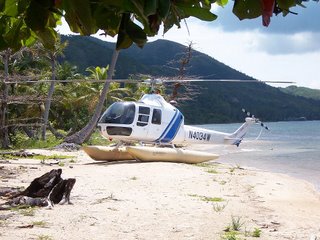
I had to actually hover in under a palm tree to get on the beach. It was tricky. Kenny, who was riding with me, said, "You are the BEST helicopter pilot!" I was inclined to agree, but modesty made me correct him. "Just *one* of the best, Kenny," I said. "Just one of them."

I probably should have landed on her boat dock, which was roomier and more solid. But the helicopter on the beach just makes such a pretty picture, doesn't it? Plus, I had never done it before.

Life in paradise has it's advantages, let me tell you.

08 October 2006

Javier

At seventeen, Javier was kind of young to be operating our front-end loader. But he had already been cutting the grass at the Guanaja airport with a fairly large tractor. He impressed us with his intelligence and maturity, so we put him to work. He handled the huge Caterpillar with deft ease, speed and proficiency. In fact, he drove all of our Cats: the loader, the track-hoe and the bulldozer (which the locals pronounce with the accent on the second syllable). Day after day, he moved tons of earth for us, non-stop, back and forth without complaint or even stopping to take a break. Dark-skinned with sharp, angular features, he always seemed to be grinning at some inside joke. It was like he knew he was special, at least compared to most of the other workers who, while older than he, spent their days shoveling sand and mixing cement. As soon as Javier saw me each morning, the sly grin would break into a wide smile and greeting.

At seventeen, Javier was already a ladies’ man. I’d recently spent a Friday evening in town on the cay carousing. Slim and strikingly handsome, the women flocked around him. Unabashedly, he flirted with them all despite the fact that he reportedly had a serious girlfriend who was conveniently off the island for a while. Something told me that he’d be just as flirtatious even if she were not. Later that same night, when I’d finally made it home to our island, it was Javier who followed us in another boat so that he and Kenny could continue partying after this old-timer had called it quits. So young and energetic, these kids here, so full of restless energy and life, doing everything at a million miles per hour, living like there was no tomorrow. And for Javier it finally came true.

THURSDAY, SEPTEMBER 28, 2006
Around ten p.m. there came a terrible banging on my door. It was our cook, clearly distraught. “There’s been a bad accident, Javier is dead?” he blurted all at once, making it sound like a question. More words spilled out frantically and I processed them as best I could to get an idea of what happened. Javier, three other boys and two young girls were out partying on the north side of the island. Somehow, they collided with another boat.

First reports (which are almost always wrong) had only four in Javier’s boat and all of them dead. At the same time it was not known how many people were involved or if all of them had been found. The head of the local power company arrived to ask if the helicopter was available should it be necessary to transport any injured. Unfortunately, nights are just too dark down here to risk flying in an unstable aircraft like a helicopter without the necessary instrumentation. Feeling like the biggest heel in the world, I said I’d have to wait until sunrise.

Tragically, it turned out that Javier’s parents, unable to contact their son by cell phone had sent another young boy out to look for them in another boat. A much bigger, more powerful boat. Inexplicably, both boats collided.

The impact from the collision had sufficient force to kill three of the boys instantaneously and seriously injure the two girls. Sadly, Javier was one of those who died. The driver of the second boat and two of the other boys in Javier’s boat escaped with only a scratch or less. The girls were taken by boat to the mainland during the night. They’re going to be okay.

How does such a thing happen? After being around here for a while, my question is why such things don’t happen more often? Theories abound about this one, as they always do. Everyone has an authoritative opinion. But I know from my knowledge of aircraft accidents that no one really knows – sometimes not even the people involved. And when you consider the elements associated with this one: young boys, alcohol, young girls, fast boats and a dark night…maybe even the people involved won’t say exactly what happened even if they do know. Right now it’s best that everyone just keep their mouths shut until things have had a chance to settle. But they don’t do that. Everyone speculates. It doesn’t help.

FRIDAY, SEPTEMBER 29, 2006
Needless to say, the island of Guanaja is dealing with a tragedy of a magnitude not seen here in a long time. Hell, the previous-worst thing to ever happen here, which pretty much destroyed the whole island but only killed two people. That was Hurricane Mitch in 1998. Today, the weather is lousy, matching our mood. This is the first day since I’ve gotten here where it’s been overcast, rainy and dismal all day long. It’s like God Himself is crying.

I had wanted to get a candid photograph of my skinny, smiling front-end loader driver in his element, in command of that big Cat with a bucket-full of black dirt. But every time Javier drove it he wore sunglasses and a baseball cap pulled down low over his eyes. Now it’s too late. As usual. (Why do we put off stuff “until later”? I know better. Still…)

SATURDAY, SEPTEMBER 30, 2006
After such a dreary Friday, today could not be more beautiful. The water inside of the reef is like a lake. It’s one of those picture-perfect Caribbean days you only see in travel brochures. We’re burying Javier this afternoon. Quick, yeah but maybe it’s better this way. No autopsy, no coroner’s inquest, no big police investigation. Life is uncomplicated for these people. There are no multiple layers of bureaucracy and government as we’re used to in the States.

And as bad as we all feel, life must go on. Javier’s father will have to keep fishing. Monday, it will be back to the business of building a marina for us. I’ll have to hire or train someone to drive the front-end loader. Replacing Javier will not be easy; he did a lot of stuff for us, both at the job site and at the airport. But I’ll worry about that on Monday.

03 October 2006

Medevac Flights

The Bay Islands are pretty remote. Not just in a physical sense - although they are 40 miles distant from the nearest mainland. But as far as Honduras' capital of Tegucigalpa is concerned, the Bay Islands may not even exist. All of the money the government has is already given out before they get down to us on the list of the needy.

Guanaja, with all of 13,000 people or so, only has marginal little medical clinic. For anything more complicated than a broken fingernail, patients are routinely sent to the city of La Ceiba on the mainland where they can receive free medical attention. To get there, they must catch one of the sporadic commuter airline flights. Takes about twenty minutes, costs about $120 round-trip.

Now that we have our helicopter down here, some of the locals assume that we run a 24/7 air ambulance. I get calls at all hours of the day and night to do "urgent" transports. Takes about 45 minutes one-way. Some we do, some we don't.

First one I did was a pretty little pregnant girl with complications, needed immediate surgery. She got it in time, and mother and child are fine. Second was a guy who was on the wrong end of a machete fight. He ended up losing the hand, lots of stitches closed his other wounds.

Third and fourth were a "two-fer." The woman who had been our longtime Postmaster on Guanaja was visiting La Ceiba when she had a serious heart attack. Her family wanted to bring her back to Guanaja to die at home. Naturally they called me. This was more of a mercy flight than anything else, but what the heck. When they loaded her onboard, it was clear that if the attending nurse stopped squeezing the oxygen bag the elderly woman would die. Which is just what she did 30 minutes after I landed her in Guanaja.

Coincidentally, as I was fueling the ship in preparation for the flight, one of our employees was at the airport and limped over to our hangar, having gotten bumped off the commuter flight due to no seats. While working, he had gotten rammed in the...well, let's say "tender region" by the handle of a wheelbarrow. His 'nads had swollen to the size of a grapefruit (this was described to me, not actually witnessed). He was walking funny. It looked painful. Local doc said he needed surgery. Instead of taking the commuter, I transported him down to La Ceiba while headed there to pick up the Postmistress.

I've had to turn down a couple of flights. One night we had a bad boating accident that killed three teenage boys and injured two teenage girls. The call came in on an overcast, moonless night not long after I'd gotten home from dinner and drinks (lots of drinks) at a local restaurant. Even without the alcohol involvement, it would have been too risky. Our FH1100 is not equipped with the necessary instrumentation needed for such a flight. And I'm just not that brave/invincible anymore. It hurts to say no, but sometimes you have to. You can't save the world.

I have no doubt that we will be doing more of these medical flights. Fortunately, the FH1100 is very easy to convert from passenger to stretcher configuration, and I can do it at an enroute stop. Donating the helicopter for such public service flights is obviously a good thing for the community. But I will not deny that it makes us feel really good to do something truly useful and helpful with the machine. My boss is an incredibly generous person. I'm not sure the community really appreciates it yet, but I have a feeling they will come to in time.

29 September 2006

I Got My Baby-Back, Baby-Back, Baby-Back

Unimpounded! Finally got the helicopter back home to Guanaja, no thanks to the Honduran "government."

Back on September 6th, Mrs. Bossman wanted to do some shopping. So I flew us from the Bay Islands down to the mainland city of La Ceiba. There, we were informed that our seven-day permit to fly in Honduras had expired. We had erroneously thought it would be a mere formaility to renew turned into a federal case. The airport manager looked at me very sternly and said, "You must go to Tegucigalpa right now to deal with this violation!" His tone indicated that I was on the verge of being arrested.

Oh yeah? Me, go to the capital of Honduras with no representation or agent, to meet with government officials who may or may not speak English and deal with a "violation?" Thaaaaaat's not gonna happen, sorry. The boss's wife sent for the plane, which spirited us out of there but quick.

Here's the King Air and the FH1100 together for the last time for a while.

We wanted a permit to fly in Honduras that was of longer duration than just one week.

The Honduras government's position was simple: If we keep the helicopter in Honduras for any length of time we'd have to put under Honduran registration. If we only intended to keep it in Honduras for a short time, we could keep renewing our weekly permit.


Lots of legal wrangling ensued. We had all sorts of help on our side, but we got nowhere for three weeks. The most likely reason I heard was that there was a new government in place, with all new department heads, and everybody was worried about making any kind of decision. They griped everything. Typo on the boss's medical certificate? No go! Then there were registration, insurance, and airworthiness issues. They even wanted to do a mechanical inspection of the ship.

Finally, they said we could come get the helicopter. We didn't have the permit, exactly, but "they" assured us we would. So my local contact and I went back down to La Ceiba...where we were stonewalled yet again. We cooled our heels as the government fussed. "Maybe tomorrow," we were told. So we stayed overnight. Next day it was one thing after another. We waited some more. I came to the conclusion they were just screwing with us, so we booked a flight out back to Guanaja (rather than sending for our King Air).

Sure enough, at the very last minute, right before close-of-business the fax from Tegucigalpa came through: a six-month permit! Paper in hand, I filed a flight plan, paid our $350 parking fee and we fled the scene like La Ceiba was on fire.


And here is my baby, back on our island, safe and sound, no worse for the wear. Yes, I should park it on the wooden platform behind the helicopter, but it just looks more picturesque on the sand, no?


23 September 2006

Reality Bites Back

Just over a month ago my reality was: Living a nice life in a small southern city and driving my car to my cushy office job every day where I spent my time on the computer and on the phone. I almost never went to the beach. And when I did, the seaweed and jellyfish were usually so bad I did not often go in the water. I bought a Glock semi-automatic pistol for "home defense" but deemed the threat of a home invasion to be so low that the gun stayed in it's case, unloaded most of the time.

Now, I live on a tiny little island and drive a boat to work every day. I swim every day in the most beautiful, clear water that you could imagine. I have not worn long pants since I got here, not even at work; most of the time I wear sandals too. I almost never talk on the phone except at the construction site, where cell phones are used like walkie-talkies. Most startling of all, there are no Wendy's down here. Talk about a reality shift! (For single guys, Wendy's and the $.99 value menu is great. Who needs to cook?) We've already had one intruder on the island trying to steal one of the boats in the middle of the night. Something tells me it's not the last time we'll be "visited" at night. The Glock now stays on my nightstand, loaded and at the ready. The night-vision goggles for me and laser-sight for the gun are on order. You can't shoot what you can't see.

I grew up in New York City in the 1960's and '70s. We did not fish. Back then, you would not want to eat anything you caught in the East or Hudson Rivers. We did not even swim in them. As a city boy, I never had the opportunity to drive a boat. Even as an adult, even living in a boaters paradise like Pensacola, that activity never interested me. Oh, I went out with a few friends on their boats occasionally, but I never drove. Ever. Now, at the ripe old age of 51 I get down here to Guanaja and suddenly I'm the boat driver. It is, ahh, interesting.

Since there are no roads on Guanaja, we use boats as employee shuttle vans, picking up groups of workers at two opposite locations from the jobsite. Every morning, I pick up 12 to 14 guys in a little 21 foot center-console outboard. Every afternoon I take them back. Calm or windy, flat water or rough. And sometimes it is very rough. Scary-rough. The lumps in my throat sometimes feel like golf balls.

So far I have not crashed the boat, capsized it or run aground. So far. I'm not saying it won't happen. The guys all look at me confidently. I can almost see what they're thinking: "Hey, he's a pilot, right? He knows what he's doing." And I pretend that I do.

After work yesterday I stayed in town. "Town" in our case is a breezy little island called Bonacca, about a half-mile out in the water toward the barrier reef. Bonacca is commonly referred to as "the cay" (pronounced kee, even though we say Cay-man Islands and not Kee-man Islands - don't ask me why some things are the way they are). Thirteen-thousand people live in Guanaja, and half of them live on the tiny, overcrowded, smelly sewer of an island of Bonacca.

The story is that Guanajarans originally moved over to the cay to escape the sand flies and mosquitoes that can be fierce on the main island. That's probably the most likely reason. You think the gnats and skeeters are bad where you are? Feh- you have no idea. Or maybe you do...IF YOU LIVE IN THE AMAZON JUNGLE... Whatever, Bonaccans built their houses up on stilts, dumped their garbage out their windows, and just ran their sink and toilet drains down open pipes to the water. Many still do. You can imagine the ambiance.

Now, the cay is a happening place, especially on a Friday night. Plenty of bars and even a dance club or two. The guys wanted to show me a good time. And we started having that good time around two p.m. with the opening of the first beers. There are a couple of local Honduran beers, and they are not bad. In fact, Salva Vida is quite good. There are not many things to do on the cay except drink. Fortunately, I've had practice. I could keep up. The beer flowed like water, the good times rolled, shots of tequila all around, the jukebox blared (strangely, they love American country music down here). Just like home. But not just like home, the local women all gathered around the rich gringo. I'll admit to being a gringo, but rich? Heh, if they only knew.

We called it quits sometime after midnight. And here's where that weird reality thing kicked in again.

We were on the way home in the boat. Kenny, the brother-in-law of our caretaker and who lives most of the time on our island was driving. He was at least as drunk as me. The night was pitch-black. He had the throttle wide-open as he usually does when he drives. Oddly, boats do not have headlights. Immediately in front of the boat was the dim glow of our puny navigation lights. The water was really rough, so I was standing up next to him. Looking forward, I could see...nothing. And I mean absolutely nothing except for four yellowish lights out on the horizon. There could have been a Navy battleship parked in front of us and we would not have seen it. "How do you know where you're going?" I yelled above the roar of the engine.

"See those lights?" Kenny asked, meaning the ones arrayed in front of us. He pointed to the right-most one. "That one is Half-Moon Cay. The middle one is us. The one to the left of that is Graham's Place."

"And what's that one all the way on the left?" I asked.
"I don't know," he shrugged. We weren't going that way anyway.

And we droned on like that for ten more minutes or so, pounding over, across and crashing through the waves (hey, maybe smaller boats for all I knew) until we got to our island. I kept staring out front, at the black nothingness and thinking, "Man, this is insane. What am I doing here?" I've done some stupid things in my life, and that was one of them.

Kenny got us home...er...safely. Well, without crashing, anyway. As I stepped onto the dock, Javier roared up in another, smaller speedboat, one with no lights. He'd left the cay ahead of us but somehow got behind us. Kenny hopped in and they sped off, back to the cay to continue partying. They do like to drink down here in Guanaja.